
If you are planning to build a house in Kathmandu, one of the important construction materials to keep an eye on is bricks. Bricks are used extensively in residential and commercial construction, and even a small increase in the price per brick can significantly affect the overall construction budget.
In 2026, the brick price in Kathmandu and across Nepal has come under upward pressure. Recent market references show standard red bricks commonly ranging around NPR 18–28 per piece, depending on quality, supplier, location, transportation and season.
More significantly, data reported by the National Statistics Office and published by The Kathmandu Post showed that the brick price index increased 13.41% year-on-year, making bricks one of the biggest contributors to the increase in construction input prices.
So, why are brick prices increasing in Kathmandu? And what does this mean for people planning to construct a house?
Let's look at it in detail.
Current Brick Prices in Nepal: September 2026 Wholesale Rates.
The actual brick price in Kathmandu can vary depending on the type and quality of brick, kiln, supplier, transportation distance and order quantity.
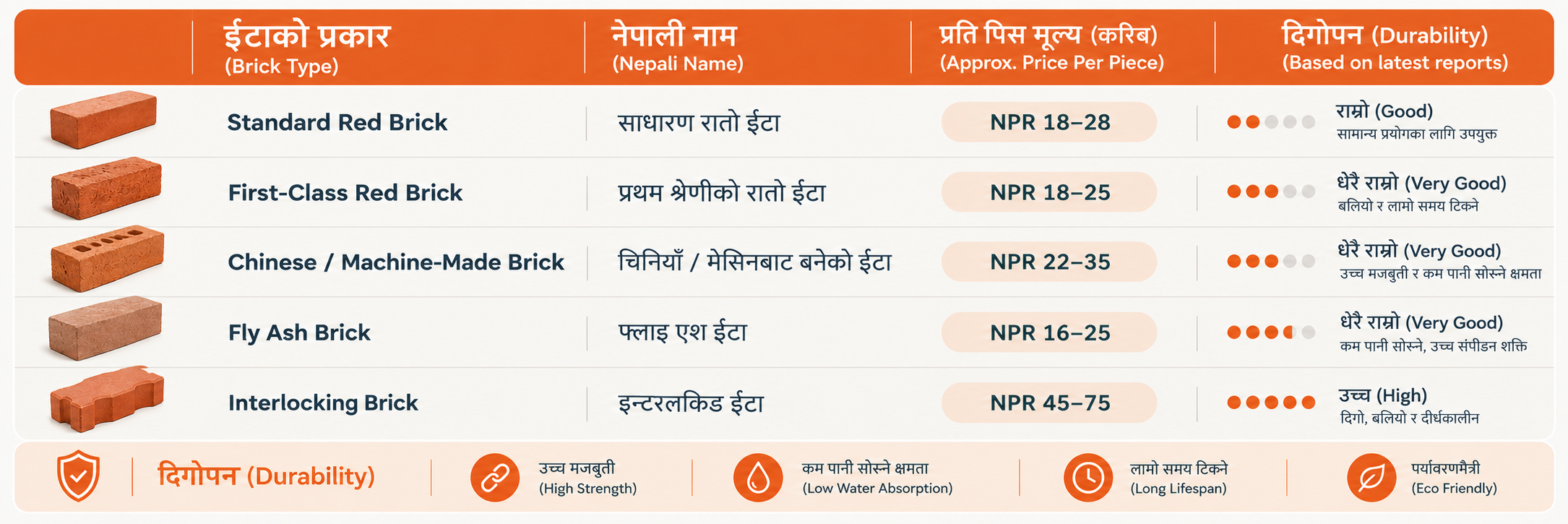
These are market reference ranges rather than fixed government rates. The final delivered price can vary considerably from one supplier and construction site to another.
For a construction project in Kathmandu Valley, it is therefore important to confirm the delivered price, rather than looking only at the supplier's per-piece rate.
Why Is the Price of Bricks Increasing in Kathmandu?
Several factors influence the brick price in Nepal.
1. Seasonal Demand
Brick production and construction activity in Nepal are highly seasonal.
The major construction season generally falls between October and April, when relatively dry weather allows more masonry and other construction work.
According to data reported by The Kathmandu Post, demand for bricks increased by 9.33% during the peak construction period, putting additional pressure on supply.
When demand rises faster than available supply, brick prices can increase.
2. Limited Brick Production During the Off-Season
Brick manufacturing in Nepal is heavily affected by the monsoon.
Many traditional kilns stop or reduce production during the rainy season, while workers may also return to their home districts for agricultural activities.
This creates a seasonal supply cycle where the availability of bricks can change significantly throughout the year.
3. Transportation and Delivery Costs
Bricks are heavy and relatively fragile construction materials.
This means transportation plays an important role in the final brick price in Kathmandu.
The price paid at the kiln is not necessarily the same as the price delivered to a construction site.
Transportation, loading, unloading and difficult site access can all increase the final cost.
This is particularly relevant in Kathmandu Valley, where some residential sites have narrow roads or difficult access for large vehicles.
4. Rising Construction Input Costs
The cost of producing and transporting construction materials is connected to fuel, logistics, labour and other operating expenses.
The latest construction input data reported by The Kathmandu Post showed that several construction materials experienced price increases, with bricks recording one of the strongest increases.
As a result, homeowners need to consider material-price fluctuations when preparing a construction budget.
How Much Does Brick Price Affect House Construction Cost?
This is where a small increase can become significant.
Suppose a house requires approximately 30,000 bricks.
If the price increases by just NPR 3 per brick:
30,000 × NPR 3 = NPR 90,000
That means a seemingly small increase in the per-piece rate can add NPR 90,000 to the material cost.
For larger houses or multi-storey buildings requiring more bricks, the impact can be even greater.
This is why proper BOQ preparation and material planning are important before starting construction.
Should You Buy Bricks in Advance?
Not necessarily.
Buying bricks early can sometimes help protect against seasonal price increases, but storing large quantities also requires:
Proper storage space
Protection from excessive moisture
Good site access
Quality inspection
Proper estimation of required quantity
Instead of simply buying the cheapest available bricks, homeowners should consider the quality, wastage, transportation and actual requirement.
The cheapest brick is not always the cheapest option in the overall project.
How to Choose Good Quality Bricks?
When purchasing bricks for house construction, don't focus only on price.
Look for bricks that are:
Uniform in size and shape
Properly burnt
Free from major cracks
Hard and durable
Consistent in colour
Not excessively porous
Suitable for the intended masonry work
A good-quality brick can help reduce unnecessary breakage and wastage during construction.
It is also important to ensure that the selected brick is appropriate for the specific application and construction specification.
How Can You Control Brick Costs During House Construction?
Here are some practical ways to manage your brick budget:
1. Prepare a BOQ Before Purchasing
A proper Bill of Quantities (BOQ) helps estimate the required quantity of bricks and other construction materials before purchasing.
2. Compare Delivered Prices
Don't compare suppliers only on the per-piece rate.
Compare:
Brick price + transportation + loading + unloading = actual delivered cost
3. Check Quality Before Bulk Purchase
Inspect samples before placing a large order.
4. Minimize Wastage
Poor handling and improper storage can increase brick breakage and unnecessary expenses.
5. Plan Material Procurement
A professional construction team can plan procurement according to the project schedule and market conditions.
What Does Rising Brick Price Mean for Homeowners?
The rising brick price in Kathmandu is another reminder that construction budgets should not be based on outdated material rates.
If you are planning to build a house in Kathmandu, your budget should consider:
Brick
Cement
Steel
Sand
Aggregate
Labour
Transportation
Electrical work
Plumbing
Doors and windows
Flooring
Painting
Interior and exterior finishing
Construction costs can change during the project, so having an accurate estimate and proper planning can help reduce unexpected expenses.
The brick price in Kathmandu in 2026 is being influenced by seasonal demand, supply constraints, transportation and broader construction input costs. Current market references show standard red bricks generally around NPR 18–28 per piece, while official-data reporting indicates a 13.41% year-on-year increase in brick prices.
For homeowners, the key is not simply finding the cheapest brick. Correct estimation, quality control, procurement planning and professional supervision can have a much bigger impact on the final construction cost.
If you are planning to build or renovate your home in Kathmandu, getting your design, BOQ and construction plan ready before purchasing materials can help you make better financial decisions.
Planning to Build Your Home?
Swastha Ghar Construction provides complete support from design and planning to construction and site supervision, helping homeowners manage their projects with proper technical planning and quality control.
Design देखि construction सम्म — तपाईंको घर, सही planning र professional supervision सहित।