
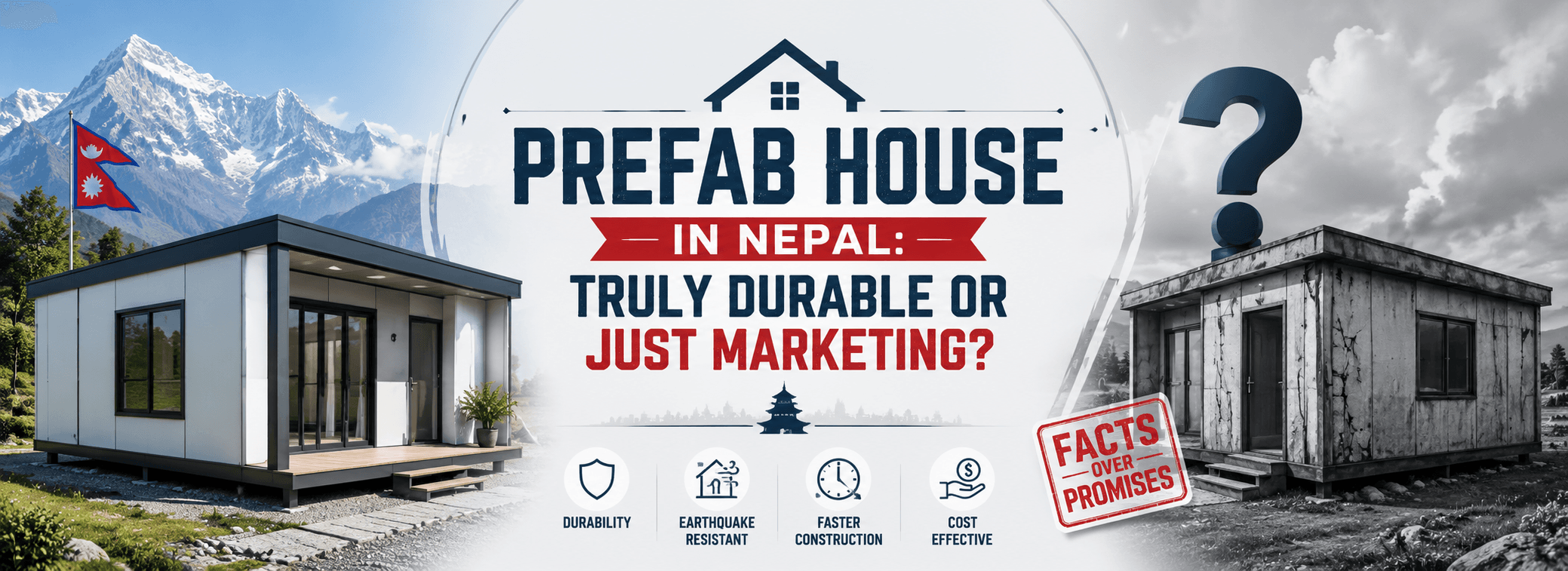
Prefab house construction in Nepal has become one of the most searched topics in the modern housing and real estate sector. With rising interest in fast construction methods, modular housing, and cost-effective building solutions, prefab technology is being heavily promoted as an alternative to traditional RCC construction. But the key question remains: Is prefab house in Nepal truly durable, or is it just marketing hype?
From a technical construction perspective, a prefab house (pre-fabricated building system) is a structure where components such as steel frames, wall panels, roof structures, and modular units are manufactured in a factory and later assembled on-site. This method is different from conventional RCC house construction, where every structural element is cast and built directly on-site. Prefab systems are designed to reduce construction time, improve manufacturing control, and provide a modern housing solution.
In Nepal, the demand for prefab homes, modular houses, and steel structure buildings is increasing due to rapid urbanization and the need for faster project completion. In ideal conditions, a properly engineered steel frame prefab house can perform well in terms of strength and seismic resistance. Especially in earthquake-prone countries like Nepal, steel-based prefab structures can offer good flexibility if designed according to proper engineering standards.
However, at Swastha Ghar’s construction experience, the reality is that prefab durability in Nepal is highly dependent on engineering design quality, material standards, structural connections, and foundation system design. A prefab structure is not automatically strong just because it is modern or factory-made. If the structural design, load calculations, and joint detailing are weak, the building may fail under long-term stress or seismic load.
One of the major concerns in the Nepal construction market is the over-marketing of prefab houses. Many companies advertise prefab construction as a low-cost, ultra-fast, and maintenance-free housing solution, but often fail to explain the technical limitations. Critical factors such as soil testing, foundation design, corrosion protection, insulation systems, and load-bearing capacity are sometimes ignored in marketing presentations. This creates a gap between expectation and real performance.
Nepal’s environmental conditions also play a major role in prefab house performance. The country experiences heavy monsoon rainfall, humidity, temperature variation, and diverse soil conditions, which directly affect building durability. Without proper corrosion-resistant materials, waterproofing systems, and thermal insulation, prefab houses may face long-term issues such as rusting in steel members, water leakage in joints, and reduced structural efficiency.
From Swastha Ghar’s professional perspective, prefab construction is neither a completely superior solution nor a failed concept. It is a modern construction technology that requires strict engineering control. When a prefab house is designed under National Building Code (NBC) compliance, proper structural engineering supervision, and high-quality material selection, it can be a safe, durable, and efficient housing option.
However, if prefab construction is used only as a shortcut for fast delivery and low cost, without proper engineering validation, it can become a risky investment. In such cases, long-term performance, safety, and structural reliability may be compromised, especially in seismic conditions like those in Nepal.
In conclusion, prefab house in Nepal is a growing construction trend in the real estate and housing industry, but its durability depends entirely on how it is designed and executed. From Swastha Ghar’s viewpoint, whether it is prefab construction, modular housing, or traditional RCC building, the true measure of quality is not speed or cost—it is engineering safety, structural integrity, and long-term durability.